NorthPara Rubber2018
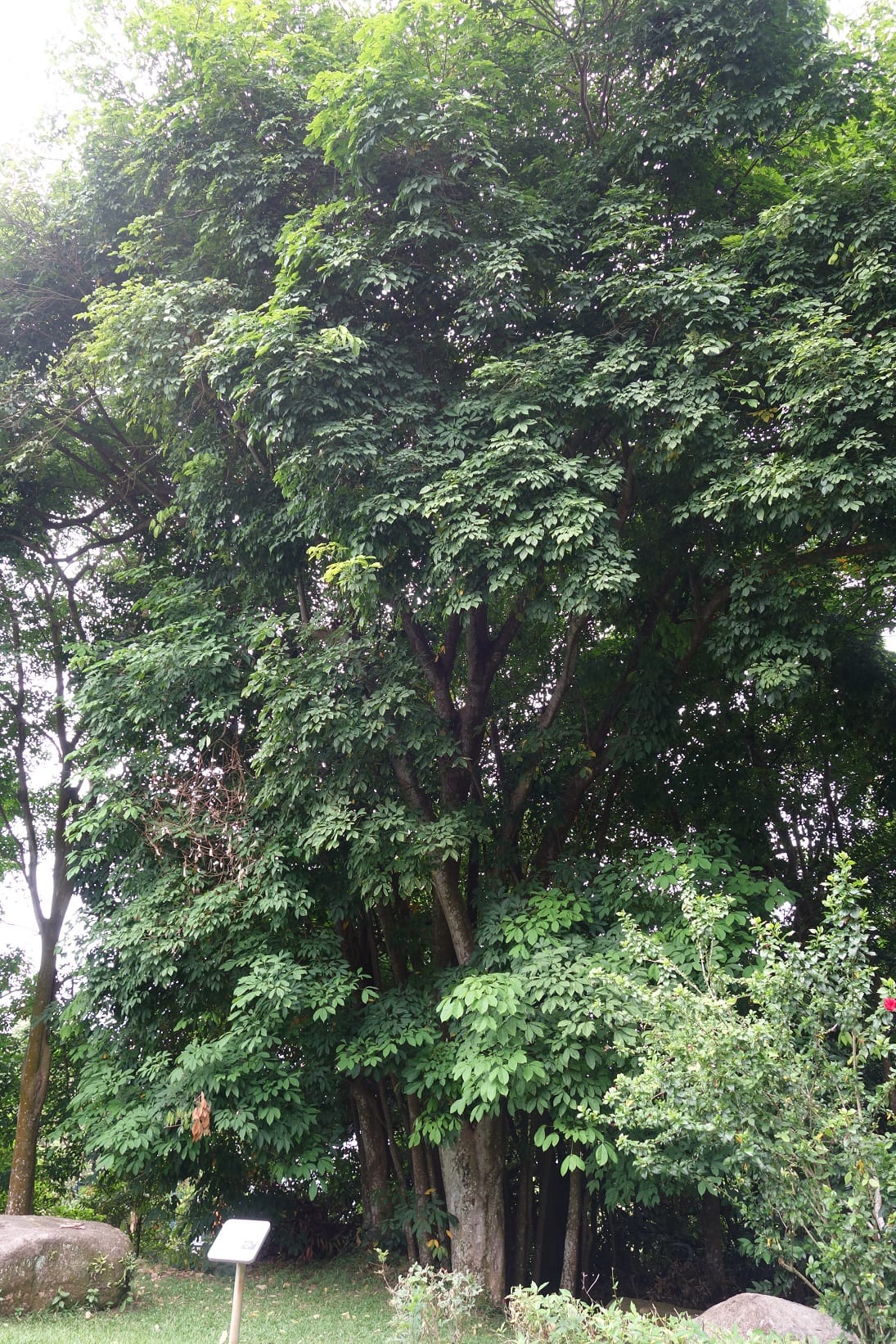
Para Rubber (HT 2018-294)
This Heritage Tree can be found in Woodlands Town Park East, near Block 103 Woodlands Street 13.
📷: Heritage Tree Secretariat
Heritage Tree Information
Reference ID | Scientific name: Hevea brasiliensis | Location |
A fast-growing tree that can reach 25 m in height, the Para Rubber originates from Tropical South America. It has greyish and smooth bark. Its leaves are alternately arranged and compound with three leaflets. The fruit is a hard pod with three compartments that explode loudly when ripe and dry, dispersing the seeds more than 20 m from the parent tree. The genus Hevea is a Latinised form of the Guyanan name, heve. The specific epithet brasiliensis refers to its Brazilian origins. The common name is probably derived from the province of Pará, Brazil.
The Para Rubber is the source of natural rubber, produced from latex obtained from tapping the trunk of the tree. The latex is derived from the inner bark and flows within the vessels of the tree. It is thought that the latex provides defense against insect predators.
In 1877, 11 Para Rubber seedlings shipped from Kew Gardens were successfully planted in the Singapore Botanic Gardens by Henry James Murton, who was the director of the Gardens from 1875 until 1880. It is believed that these plants were the source of the rubber trees that started the rubber industry in the region.
This Para Rubber Heritage Tree is likely a remnant of the rubber plantation that cover much of the North of Singapore. This plantation can be traced back as early as 1927, as seen in old topographical maps. It was estimated to be more than 50 years of age when it was endorsed as a Heritage Tree in 2018.
For more information on this species, please refer to NParks' Flora & Fauna Web profile. (opens in new tab)