
CentralBelinjau2017
Belinjau (HT 2017-291)
This Heritage Tree can be found in Singapore Botanic Gardens, behind the Garage.
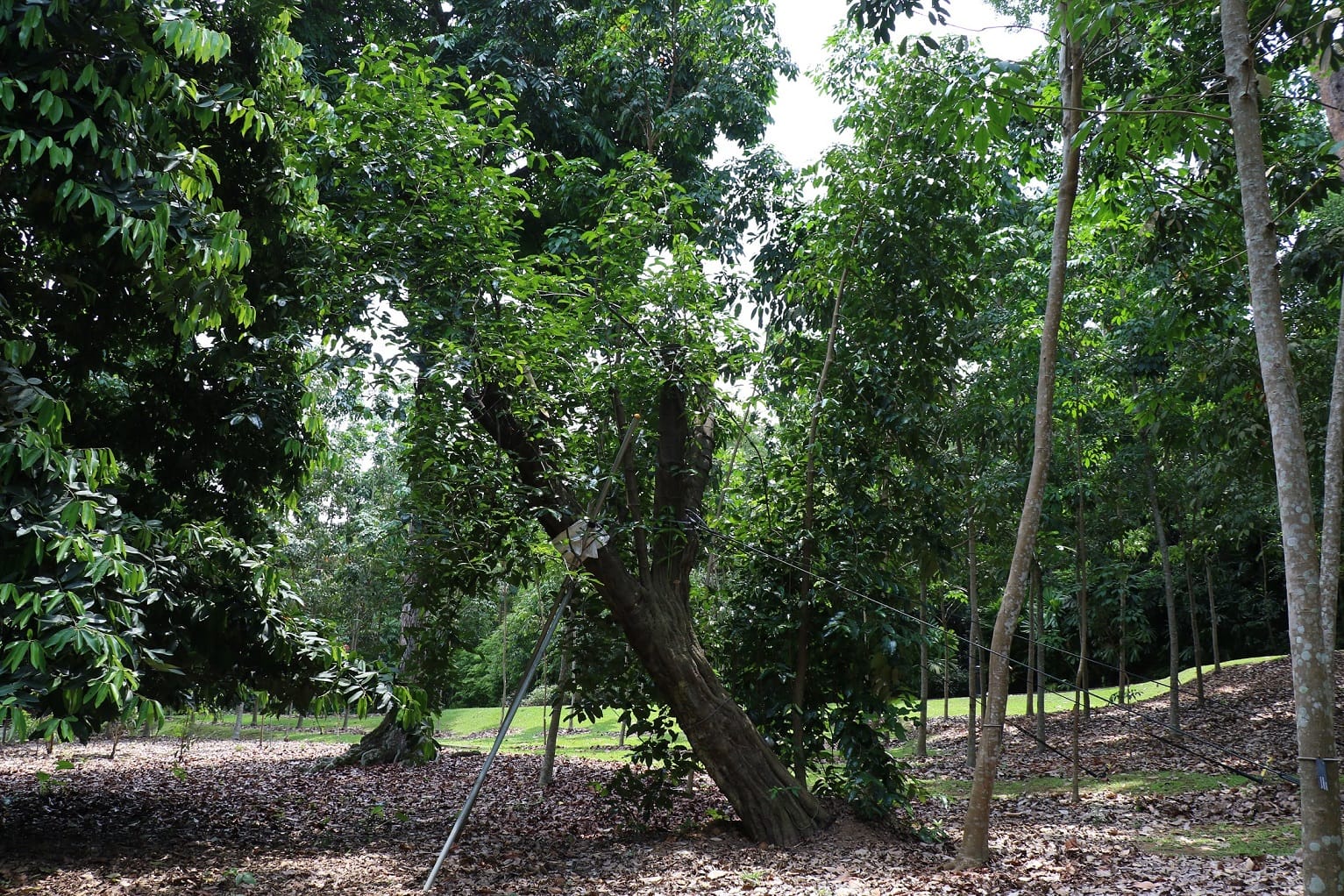
📷: Hazri Boey
Heritage Tree Information
Reference ID | Scientific name: Gnetum gnemon | Location |
The Belinjau is an evergreen tree that can reach up to 22 m in height. It is native from Assam, through Thailand, Peninsular Malaysia, Singapore, and the Philippines, to Sumba, Celebes, New Guinea, Solomon Islands, and Fiji. Populations in the wild are Critically Endangered in Singapore.
The species is remarkable for possessing features of both the flowering plants (angiosperms) and the conifers (gymnosperms). A clear characteristic of its identity as a conifer is the presence of naked seeds on the female cones. However, unlike typical conifers, the cones of the Belinjau come without cone-scales. The tree has a single trunk marked with rings (leaf scars at the nodes) and a cylindrical crown. The drooping branches develop in whorls along the stem and twigs are swollen at the nodes. The simple leaves are broadly elliptical in shape and arranged in opposite pairs.
Besides being planted to landscape and beautify a garden, the tree is cultivated widely in South East Asia where the young leaves and the cones are used as vegetables. Young leaves if eaten raw can cause irritation in the mouth. The kernel of the seed is flattened, dried and fried into a crisp known as emping or emping belinjau, which are often flavoured to be salty, sweet or slightly spicy, as the crisp tastes bitter on its own.
For more information on this species, please refer to NParks' Flora & Fauna Web profile. (opens in new tab)