
EastMadras Thorn2016
Madras Thorn (HT 2016-275)
This Heritage Tree can be found in Marine Parade Rd Park & Playground.
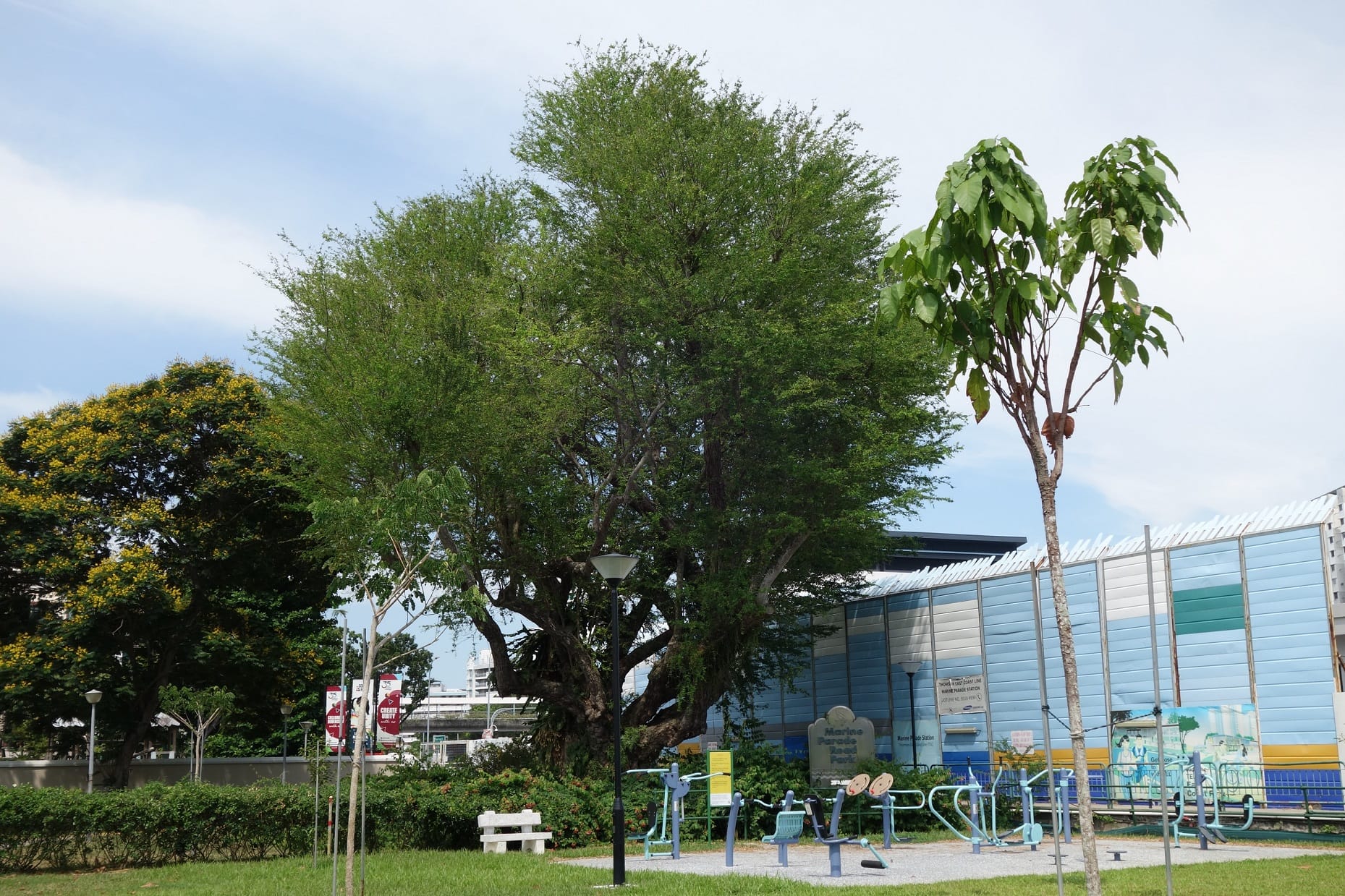
📷: Brendon Phuah
Heritage Tree Information
Reference ID | Scientific name: Pithecellobium dulce | Location |
The Madras Thorn is a medium-sized tree that can grow up to 15 m in height. The crown is spreading, relatively low, and bushy in appearance. Its leaves are held in pairs of tiny leaflets on either side of the leaf stalk, but their beauty is tempered by the sharp thorns that lie at their bases. The tiny white flowers have numerous conspicuous stamens and are borne in heads of 10 to 20 on stalks that reach 30 cm or more in length. Its fruit is a coiled pod which ripens with a tinge of rose-red and splits open to expose thick white pulp surrounding shiny black seeds that seem to hang out on short, rose-red ‘strings’.
The edible pulp attracts birds like the Yellow-vented Bulbul (Pycnonotus goiavier) (opens in new tab) and the Oriental Magpie Robin (Copsychus saularis) (opens in new tab), which help to disperse its seeds. This species is also one of the host plants for the Common Grass Yellow (Eurema hecabe contubernalis) (opens in new tab).
The genus Pithecellobium is derived from the Greek pithekos, meaning ‘monkey, ape’, and ellobion, meaning 'earring', which refers to the coiled shape of the fruit pod. Its specific epithet dulce means ‘sweet’, referring to sweet seed aril.
A native of tropical America, the Madras Thorn was introduced to this region by the Portuguese and Spanish. This species is useful in many ways — its leaves and pods serve as fodder; its wood can be used in rough construction or as firewood; its bark yields gum and tannin; and its pulp can be eaten or made into a juice.
Once a commonly planted roadside tree in Singapore during the 1970s, the Madras Thorn often suffered from caterpillar attacks and was subsequently phased out from planting in housing estates and along roadsides.
For more information on this species, please refer to NParks Flora & Fauna Web profile. (opens in new tab)