
CentralJelutong2015
Jelutong (HT 2015-239)
This Heritage Tree can be found in Singapore Botanic Gardens at the Rainforest entrance, near Lower Ring Rd.
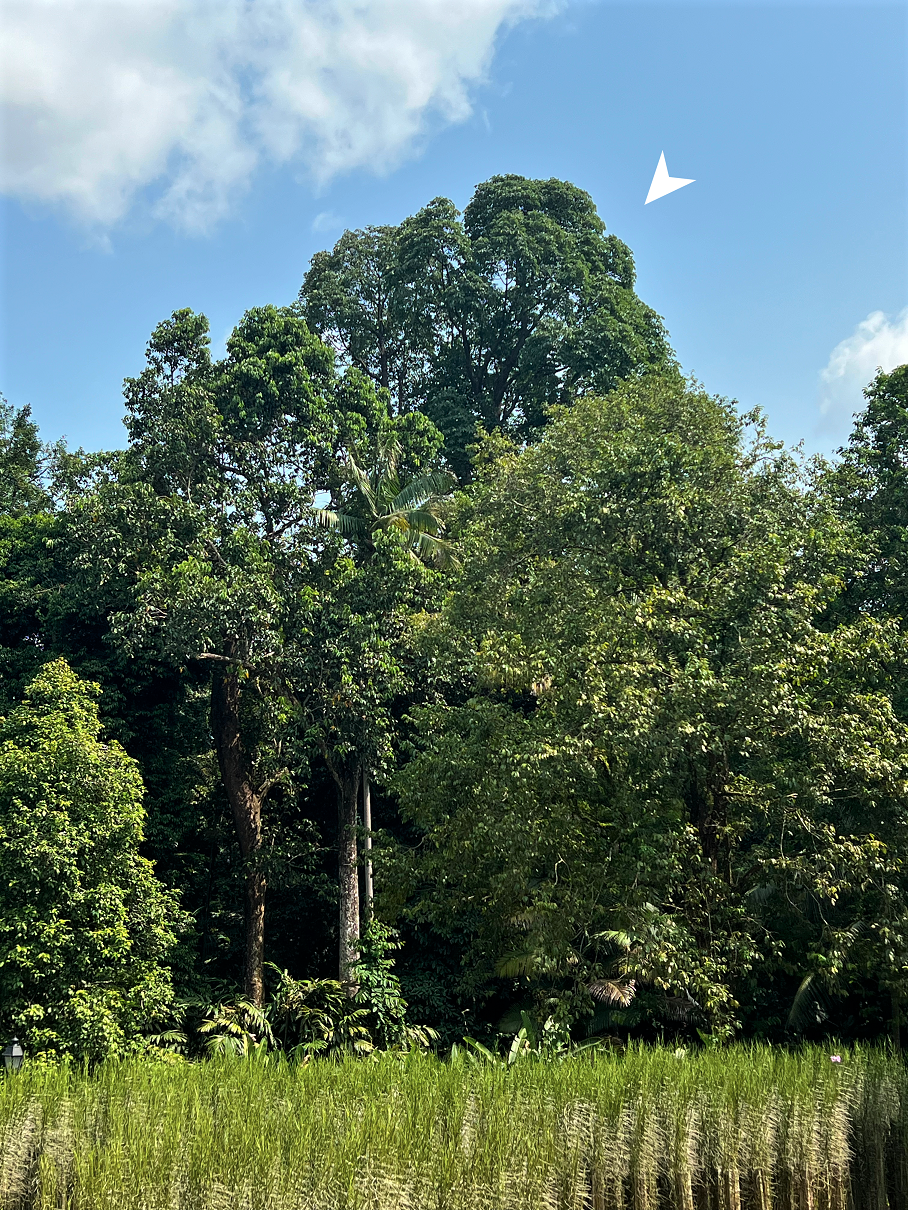
📷: Hazri Boey
Heritage Tree Information
Reference ID | Scientific name: Dyera costulata | Location |
The Jelutong is a emergent tree that is native to Singapore and can grow to over 80 m tall. It can also be found naturally distributed in the forests of Southern Thailand, Sumatra, Peninsular Malaysia, and Borneo. Jelutong trees may be often recognised from their huge lofty crowns, commonly raised above the rest of the canopy. The crown is very unlike the Common Pulai (Alstonia angustiloba) (opens in new tab), being dense and dome-like, comprising many ascending limbs, each of which ends in a conical head of foliage. Its leaves are arranged in whorls, emerging in reddish-pink hue before turning green.
The flowers are 5 petaled, tubular, and either white, yellowish-green or pinkish yellow in colour. They bloom at night between 5 - 7 pm and fall off by the next morning. The fruit is woody follicle, arranged in a pair, up to 40 cm long, and splits upon maturity releasing flattened elliptic seeds with a membranous wing.
The latex tapped from the Jelutong is called gutta jelutong and was once commonly used as the base for producing chewing gum. The wood of the Jelutong can be used to manufacture wood-cased pencils.
The genus Dyera was named after Sir William T. Thiselton-Dyer, an English botanist and former director of the Royal Botanic Gardens, Kew. The species epithet costulatus means 'finely ribbed', possibly referring to the ribbed twigs.
For more information on this species, please refer to NParks' Flora & Fauna Web profile. (opens in new tab)