
CentralEarpod Tree2001
Earpod Tree (HT 2001-11)
This Heritage Tree can be found in Fort Canning Park, along path behind the Fort Wall and The Legends.
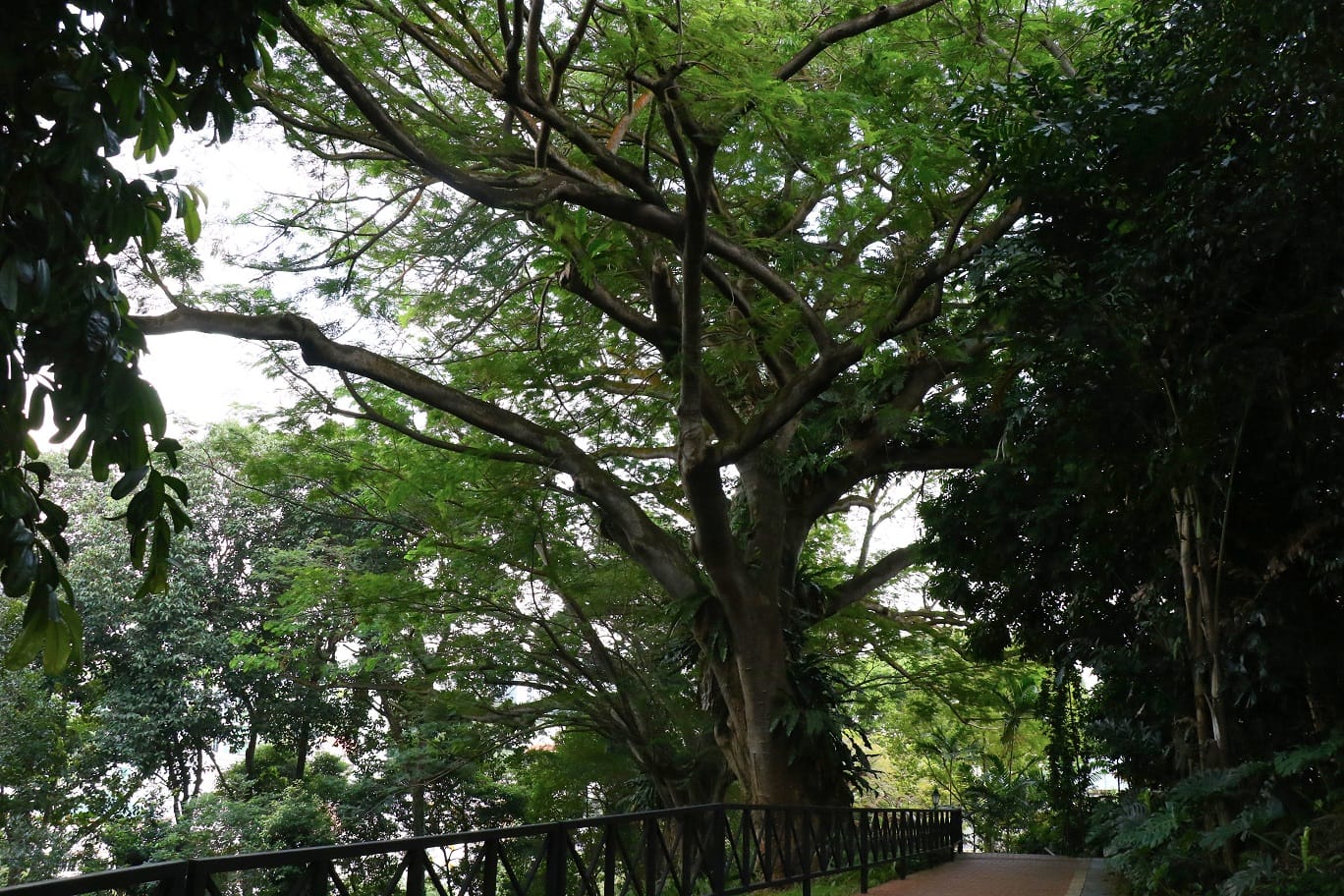
📷: Hazri Boey
Heritage Tree Information
Reference ID | Scientific name: Enterolobium cyclocarpum | Location |
The Earpod Tree or Enterolobium cyclocarpum is native to Brazil, Colombia, Guyana, Mexico, United States of America and Venezuela. It is one of the largest trees in the dry forest formation, reaching up to 40 m in height and 3 m in diameter, with a huge, spreading crown. Older Earpod Trees develop small buttresses and produce large roots that run along the surface of the ground for 2-3 m. Sidewalks, roads, or foundations may be cracked or raised by the Earpod Trees growing close by. The bipinnate compound leaves of Earpod Trees have 5 opposite leaflets. The small white flowers occur in compact, round heads. Seeds contained in distinctive, thickened, contorted, indehiscent pods that resemble an ear in form. Hence, the common name. Adult trees produce about 2000 pods, each with 10-16 seeds.
Immature pods can be cooked as a vegetable, or the seeds toasted and ground. The tree produces large quantities of nutritious pods containing a sugary pulp, which livestock consume readily, and the foliage is also palatable, though to a lesser extent.
The wood has several industrial and construction applications. It produces quality paper, and the heartwood, reddish-brown and coarse-textured, is moderately durable and resistant to dry-wood termites. This makes it suitable for house construction, interior panelling, and boat building. The white sapwood, however, is susceptible to insect attack. Tannin from the pods and bark is used in soap making, and bark extracts are used medicinally against colds and bronchitis.
The tree also provides valuable services. Its wide-spreading canopy makes it an ideal shade tree for livestock and perennial crops such as coffee, and it is a popular choice for roadsides and urban planting. Its ability to fix nitrogen and sprout vigorously when coppiced points to a possible role as a hedgerow species in alley-cropping systems.
This Heritage Tree had a girth of 5.2 m when measured in 2001.
For more information on this species, please refer to NParks Flora & Fauna Web profile. (opens in new tab)